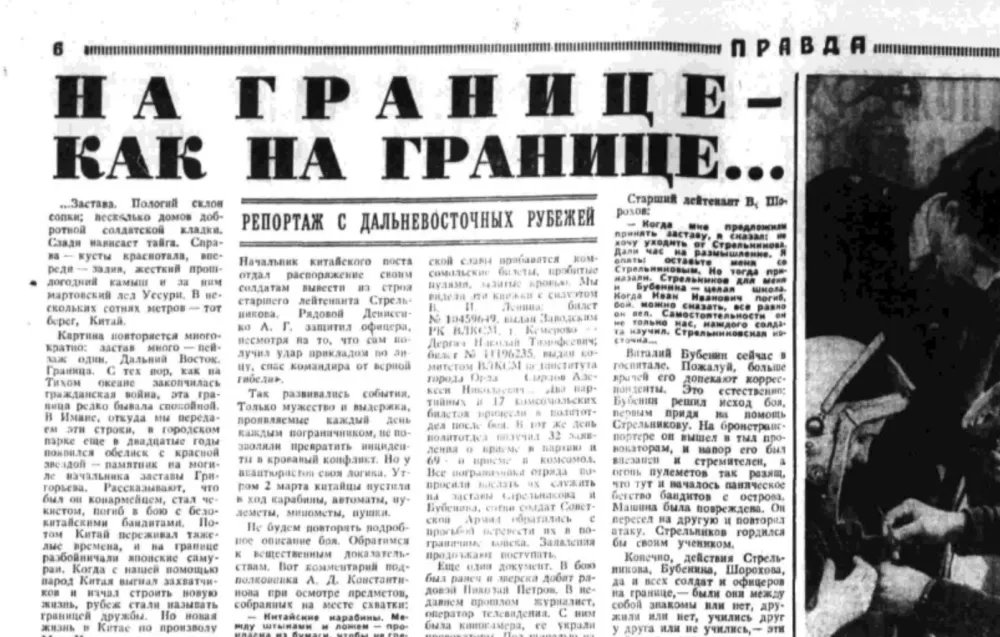
REPORT FROM THE FAR EASTERN FRONTIERS
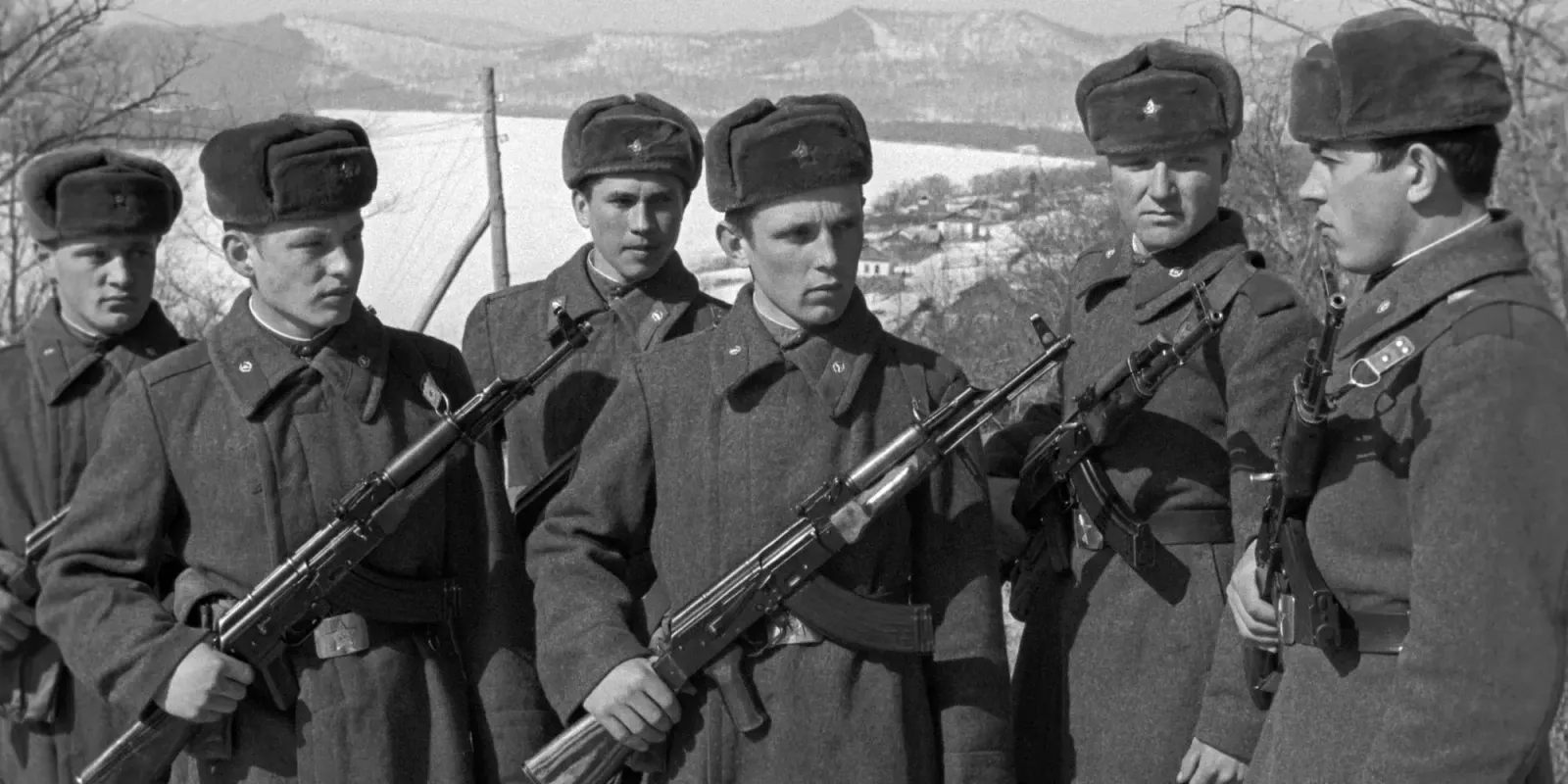
...The outpost. A gentle slope of a hill covered with several rows of barbed wire, observation towers, a control-and-trace strip like a neat path along the wire. Below, in a hollow, are the barracks and service buildings. To the right, a snow-covered, dormant river—the Ussuri. The border runs along its middle. On the far side is a low, treeless bank. Bushes, and beyond them, China.
The outpost, named after hero-border guard Peter Ovchinnikov, who died here in battle with the Japanese samurai in the thirties, has been living a tense but ordinary life. The border is the border. Just a year and a half ago, the atmosphere here was different. From the park with its twenty-year-old poplars planted by the first commander of the outpost, one could see Chinese children bathing. Fishermen would peacefully cast their nets. Then the situation began to change. First, the Chinese stopped responding to greetings. Then they started shouting threats. Life on the border became more and more difficult. The work of the border guards, already demanding the utmost vigilance, became even more intense.
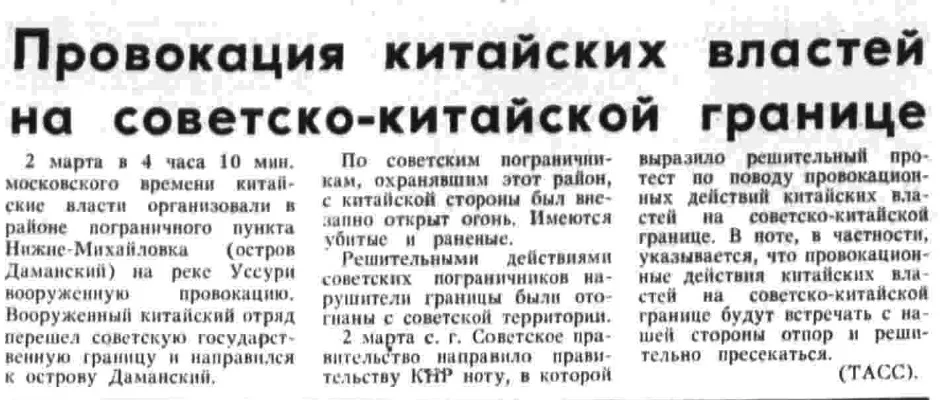
The bandit-like provocation on March 2, unprecedented in its treachery, was not something the border guards expected. Yes, they had noticed signs of preparation. Here, at the site of the incident, local residents who were working nearby had their documents checked a few days before the provocation. The location for the armed attack—Damansky Island, part of the Pozharsky district of the Primorsky Krai—was chosen not by chance. The low-lying, swampy terrain, the dense Kulebyakinskaya forest, the numerous river channels, and the islands allowed the provocateurs to approach covertly.
The commander of the outpost, Senior Lieutenant Ivan Ivanovich Strelnikov, knew the situation well, understood its peculiarities, and the short-tempered, boastful nature of the Maoists. He and his soldiers had more than once calmly and eloquently repulsed the hooligan antics of the provocateurs.
"The situation is this," recalls Junior Sergeant Yuri Babansky, "a group is approaching our border. We see them from the observation tower. The 'on duty' unit moves out to the line. Thirty people. They crossed the border and are moving towards Damansky. They are walking in a dispersed formation. Our unit, led by the outpost commander Strelnikov, moves out to meet them. We have eight people. I was in this group. As usual, Strelnikov walked ahead of us. We have photographs of him. His face is ordinary, Russian, kind. He was always calm. He always walked ahead of the line. So it was this time. We followed him. The Chinese stood in a line. Strelnikov went to them to protest and demand they leave our territory. We saw that they were armed. But they held their submachine guns and carbines with the barrels down, slung over their chests. This is the normal way of carrying them. It doesn't indicate a readiness for immediate combat. As Strelnikov approached the Chinese, the first line parted, and from the second line, from under their white camouflage robes, they opened fire with submachine guns at point-blank range."
The outpost "Nizhne-Mikhailovka." An emergency report was received at the command post. Senior Lieutenant Vitaly Bubenin, commander of the neighboring outpost, was here on business. Within 15 minutes, he was in an armored personnel carrier (APC) with 25 border guards heading for Damansky Island. In response to the demand to cease fire, the Chinese intensified their shooting. They had prepared for the armed provocation in advance, setting up machine guns and mortars on the border and their side of the island. The group led by Senior Lieutenant Bubenin and the personnel of Strelnikov's outpost, who had come to the aid of their comrades, engaged in a fierce battle.
The chief of the Chinese border post sent his soldiers to die while he himself, together with the instigators of the provocation, watched the bloody events from an observation tower. Private Rabovich, who was with Strelnikov, recalls what happened next: "We approached them. Strelnikov started to say something, but they suddenly raised their submachine guns and opened fire. I was wounded immediately. Then another bullet hit my arm. I saw Strelnikov fall."
Courage and heroism were displayed in this unequal battle by the Soviet border guards. Junior Sergeant Vladimir Kozus says: "Yuri Babansky's section distinguished itself. He acted heroically."
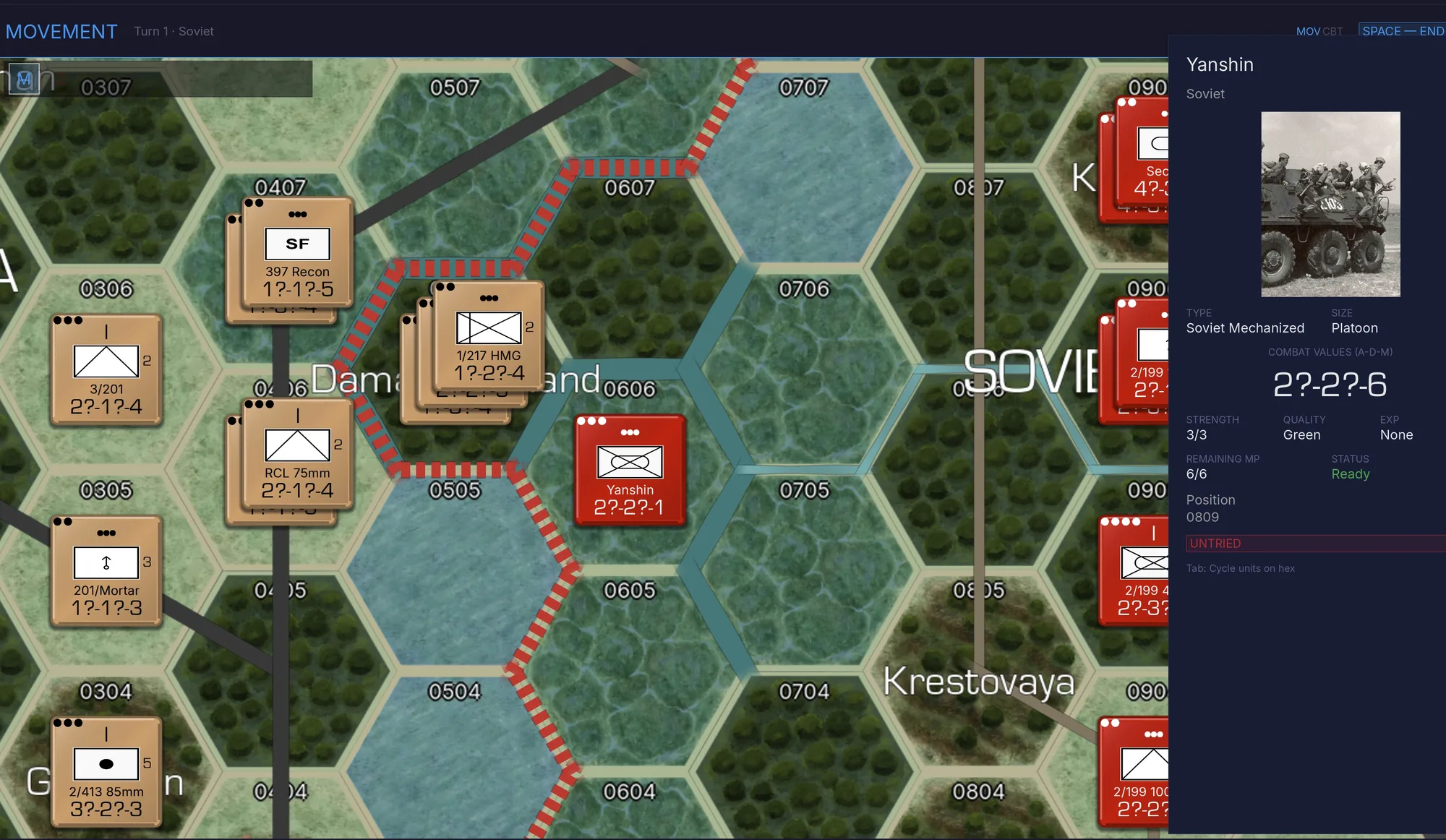
Then events unfolded like this. The Soviet soldiers, showing unparalleled courage, repulsed the attacks of the numerically superior enemy. The crew of an APC, which was providing fire support, acted heroically. Political officer Captain Buinevich was killed by an enemy bullet. After Strelnikov was killed, Junior Sergeant Yanshin took command. Wounded, he continued to fight.
"My comrades were killed," says Sergeant Rabovich, "I saw the political officer fall. I was hit by four bullets, my arm was broken, but I kept shooting until I lost consciousness. Only when I came to in the hospital did I realize my rifle was gone."
The Maoist provocateurs mocked the wounded and killed border guards. They finished off the wounded with shots to the face and bayonets.
I saw the medical report. It read: "Cause of death: gunshot wound to the head... gunshot wound to the chest." This means the soldiers were finished off at point-blank range. My companion points to a stack of letters on the table. "Read this. This is a letter from Pavel Akulov, a junior sergeant, who was killed. He wrote to his brother in the Saratov region."
Here is the letter: "Hello, my dear brother Sasha! I was very happy to receive your letter... Life is going well. Service is fine... Sasha, you write that you envy me. I understand, you also want to serve. It's time, Sasha, it's time! Our life and my service are dedicated to ensuring that our mothers sleep peacefully and that our younger brothers grow up as worthy sons of our homeland."
And one more document. Here is an excerpt from the Komsomol character reference for private Nikolai Petrov, killed by the provocateurs, from the village of Verkhnyaya Tishanka, Voronezh Oblast: "He is a morally stable, ideologically mature, and disciplined Komsomol member... He actively participates in public life... He is politically literate."
The provocateurs, these renegades who have betrayed the interests of socialism and friendship between peoples, treacherously attacked our border guards—the sons, brothers, and husbands of Soviet people. Strelnikov and the political officer Buinevich, privates Dergach and Shestakov were married. And here are the names of some of the other fallen heroes: Sergeant Yanshin from the city of Prokopyevsk, Kemerovo Oblast, Junior Sergeant Akulov from the city of Balakovo, Saratov Oblast, Private Serebrov from the village of Borovlyanka, Altai Krai.
A hospital ward. The wounded are here. The head of the medical service says: "The nature of the wounds indicates that the Maoists used dum-dum bullets, which are prohibited by international convention. You see for yourself." Indeed, the wounds are terrible.
Junior Sergeant Vladimir Zadorozhny: "I saw Strelnikov fall. He was five meters from me. He was hit by a burst of fire in the chest. I rushed to him, but it was already too late. I was also wounded..."
Private Nikolai Dergach: "I was with Strelnikov's group. They shot me in the back. I lost consciousness. I only remember them shouting 'Hurrah' when our APC arrived..."
Sergeant Yuri Babansky: "It all happened so suddenly that in the first seconds I was stunned. I fell, took cover behind a snowdrift, and opened fire. I saw our guys falling. I saw the commander fall..."
Sergeant Lieutenant V. Bubenin is lying on a hospital bed. He has a concussion. He is forbidden to talk, but for the Pravda correspondent, an exception is made. "When my APC arrived at the scene, the battle was already in full swing. We came under heavy fire. The APC's wheels and observation devices were shot out. The vehicle was damaged. I got out of the APC and, together with the soldiers, continued the battle. I saw another APC arriving to help. Its commander was killed. I got into this machine and went around the flank of the Chinese who had entrenched themselves on the island. We broke through to their rear. I saw their command post and destroyed it with fire from the APC. My vehicle was hit. I was wounded and concussed, but I continued to direct the battle."
The courage of the Soviet border guards, their boundless devotion to their homeland and the cause of Lenin, and their hatred for the enemies of socialism were instilled in them by their families, the school, the Komsomol, and the entire Soviet way of life. The border guards are the pride of the people. It is a great honor for a young man to serve on the border.
"This is not just a service," says Vitaly Bubenin, "it is a school of life. My father was a partisan. He often told me about the war, and I have always dreamed of a military career."
Here is another of the brightest manifestations of Soviet patriotism, of the deep connection between the people and their army. Four Kutyev brothers served as border guards in the Far East. And today, in many cities and villages of our vast country, young men are meeting with border guards who are on leave, envying them and dreaming of the day they will wear the green cap.
...The outpost. The same observation towers. The same barbed wire. A new detachment of border guards has arrived to replace the fallen. The border lives its tense life. Day and night, the sentinels are on duty, vigilantly guarding the sacred frontiers of our socialist homeland.
Yu. APCHENKO, Special Correspondent for Pravda.